Clean windows make a noticeable difference in the appearance of homes, offices, storefronts, and commercial buildings. However, achieving a clear, streak-free finish can be challenging when ordinary tap water leaves mineral deposits behind. Even after glass has been washed thoroughly, dissolved minerals can remain on the surface as the water evaporates, creating spots and cloudy marks.
Pure water fed pole window cleaning offers an effective approach to addressing this problem. By using purified water and specialized pole systems, window cleaners can remove dirt from glass without leaving the mineral residue commonly associated with untreated water. This method also allows technicians to clean many upper-story windows from the ground, reducing the need for ladders in suitable situations.
At Sparkle Windows, we understand the importance of choosing appropriate cleaning methods and equipment for different properties. In this guide, we explain how pure water systems work, the differences between reverse osmosis and deionization, the role of TDS meters and carbon filters, and how water-fed poles support efficient exterior window cleaning.
What Is Pure Water Fed Pole Window Cleaning?
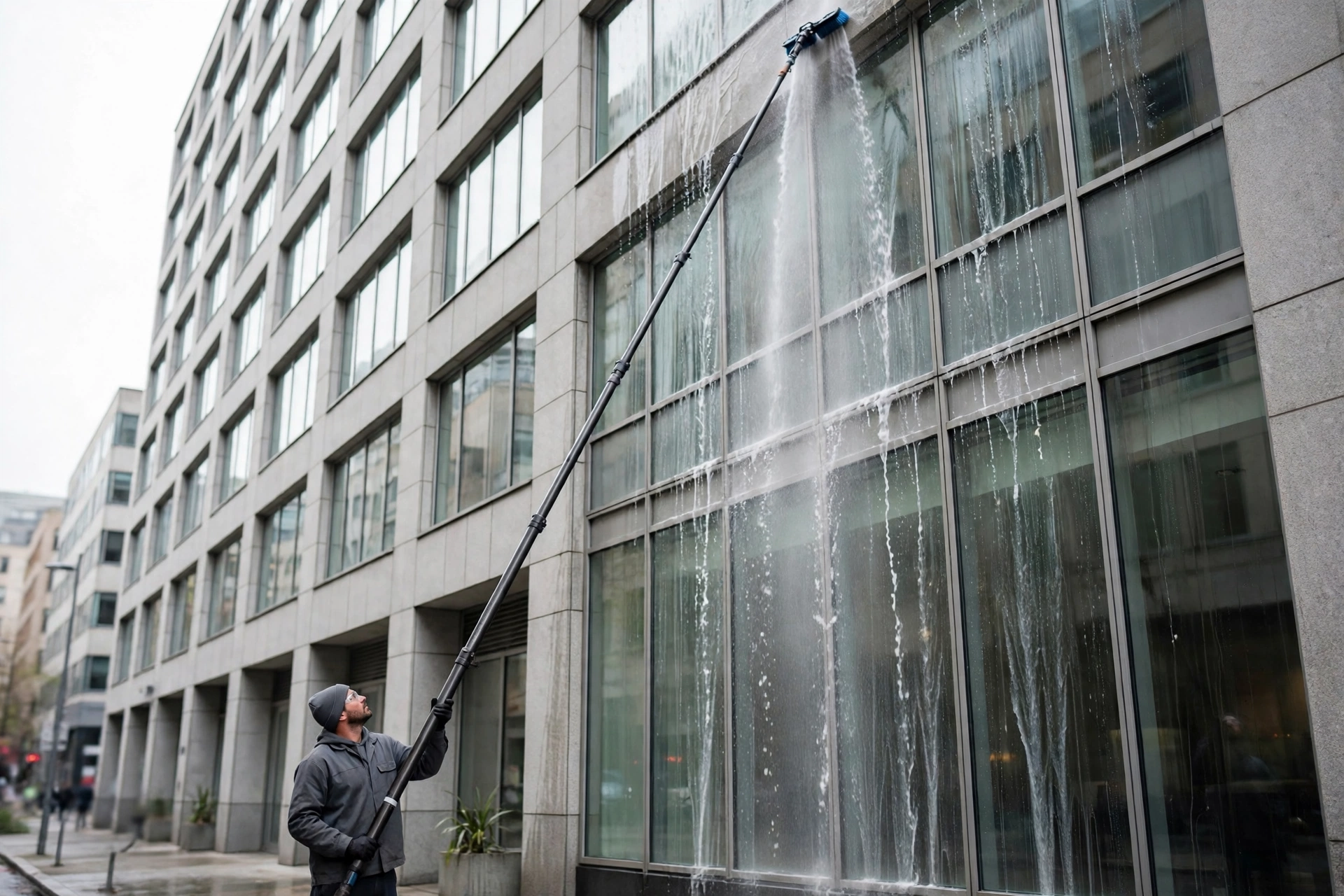
Pure water fed pole window cleaning uses specially treated water delivered through a long, extendable pole to clean exterior glass. The pole contains a water channel that supplies purified water to a brush positioned at its end.
The technician uses the brush to loosen dirt, dust, pollen, and other surface contaminants. The glass is then rinsed with purified water, which can dry without leaving the mineral spots associated with ordinary tap water when the purification system is working correctly.
Unlike traditional window cleaning, which often relies on a squeegee to remove water from the glass, this method generally allows the window to air-dry after a thorough pure-water rinse.
The process usually involves three main components:
Water purification equipment: Removes dissolved minerals and other unwanted substances from the water.
Water-fed pole: Delivers water to windows at different heights while allowing the technician to work from the ground where access permits.
Specialized brush: Loosens dirt from the glass and helps clean suitable frames and edges.
This combination can make exterior window maintenance more efficient, particularly for buildings with numerous windows or difficult-to-reach glass surfaces.
Why Use Pure Water for Window Cleaning?
Tap water contains dissolved minerals, including calcium and magnesium. The exact concentration varies according to the local water supply.
When untreated water is applied to glass, the water eventually evaporates, but some dissolved minerals remain. These deposits can create visible spots and streaks, especially on windows exposed to direct sunlight.
Pure water has had most of these dissolved impurities removed. When applied correctly, it helps reduce mineral residue and supports a clean, clear finish.
Benefits of a Spot Free Window Rinse
A spot free window rinse is one of the main advantages of a properly maintained pure water cleaning system.
Because purified water contains very low levels of dissolved minerals, it is less likely to leave visible mineral deposits as it dries. This is especially useful for exterior glass that would otherwise be difficult to reach with a traditional squeegee.
Other benefits include:
Reduced mineral spotting: Helps prevent the white marks associated with dissolved minerals.
Efficient rinsing: Allows loosened dirt to be rinsed away without introducing substantial mineral residue.
Improved access: Makes it possible to clean many upper-story windows from the ground.
Less ladder use: Reduces the need for ladders in suitable cleaning situations, although some locations still require specialized access equipment.
Consistent results: Proper water purification and cleaning technique help produce a more uniform finish across multiple windows.
Pure water does not automatically guarantee spotless glass. Dirty brushes, contaminated water, inadequate rinsing, heavy deposits, and unsuitable weather conditions can still affect the final result.
How Does a Pure Water Window Cleaning System Work?
A professional pure water window cleaning system treats ordinary water before delivering it to the cleaning pole. Depending on the equipment and source-water quality, the process may involve sediment filtration, carbon filtration, reverse osmosis, and deionization.
Each stage serves a different purpose.
1. Sediment Filtration
Sediment filters remove suspended particles such as sand, rust, and other physical debris. These particles can interfere with downstream filtration equipment and contribute to premature filter wear.
Removing them early helps protect the other components of the purification system.
2. Carbon Filtration
Carbon filters help remove chlorine and certain organic compounds from incoming water. This is particularly important when the system uses a reverse osmosis membrane that may be sensitive to chlorine exposure.
The effectiveness of a carbon filter depends on its design, condition, and the quality of the incoming water. Filters must be replaced according to the manufacturer’s guidance.
3. Reverse Osmosis
Reverse osmosis, commonly called RO, uses pressure to move water through a semipermeable membrane. The membrane allows water to pass while rejecting a large proportion of dissolved salts and other impurities.
RO reduces the dissolved mineral content of the water, making it an important stage in many professional window cleaning systems.
However, reverse osmosis does not remove every dissolved substance. The performance of the membrane depends on factors such as feed-water quality, operating pressure, temperature, and membrane condition.
4. Deionization
Deionization, or DI, uses ion-exchange resin to remove remaining charged dissolved ions from water.
In many window cleaning systems, DI filtration follows reverse osmosis to reduce the residual mineral content even further. Some systems use DI as the primary purification method, depending on local water quality and operating requirements.
The result is water with a very low concentration of dissolved ions, suitable for producing a spot-resistant rinse when handled correctly.
RO DI Water Window Washing: Understanding the Difference
Reverse osmosis and deionization are related but distinct water purification processes. Understanding their roles helps property owners and cleaning professionals appreciate why multi-stage systems are commonly used.
Reverse Osmosis Water
RO systems reduce dissolved salts by pushing water through a specialized membrane. They are particularly useful when the incoming water contains a relatively high level of dissolved minerals.
Because the membrane rejects much of the dissolved material, it reduces the workload placed on the deionization stage.
Deionized Water
DI systems use ion-exchange materials to remove dissolved charged ions. When properly maintained, a DI system can produce water with very low conductivity and very low total dissolved solids.
However, DI resin can become exhausted. If it is not replaced or regenerated at the appropriate time, the quality of the output water may deteriorate.
Why Combine RO and DI?
RO DI water window washing combines the strengths of both processes.
Reverse osmosis removes a large proportion of dissolved contaminants, while deionization polishes the water by removing remaining ions. This arrangement can help extend resin life compared with using DI alone, although actual performance depends on feed-water quality and system design.
For professional cleaning operations, this combination can provide a practical balance between water quality, operating costs, and filtration maintenance.
What Is a TDS Meter and Why Does It Matter?
TDS stands for Total Dissolved Solids. It refers to the concentration of dissolved substances in water, commonly expressed in parts per million, or ppm.
A TDS meter estimates dissolved-solids concentration by measuring electrical conductivity and converting that measurement into an approximate TDS value. It does not directly identify every substance present in the water.
For window cleaning, a TDS meter is useful because it helps technicians monitor whether their purification system is producing water with a sufficiently low dissolved-solids reading.
Checking Water Quality Before Cleaning
Technicians can measure incoming water and compare it with the output from the purification system. This helps establish how much dissolved material the filters and membranes are removing.
For example, if tap water has a relatively high TDS reading, a properly functioning RO/DI system should generally produce water with a much lower reading.
Monitoring DI Resin Performance
A rising output TDS reading can indicate that the deionization resin is becoming exhausted or that another part of the system requires attention.
Monitoring the reading helps technicians decide when to inspect the equipment, replace resin, or investigate a filtration problem.
Supporting Streak Free Glass Technology
Streak free glass technology depends on several factors, including water quality, brush cleanliness, effective dirt removal, and a thorough final rinse.
A low TDS reading is an important indicator, but it is not the only measure of cleaning performance. Glass can still appear streaky if detergent residue, greasy contamination, or dirt remains on the surface.
Regular water testing helps maintain consistent results and reduces the likelihood of mineral spotting.
Water-Fed Pole Reach: Cleaning Windows Up to Four Stories
One of the major advantages of a water-fed pole system is its ability to reach elevated windows from ground level.
Depending on the pole design, working conditions, building layout, and technician’s experience, some systems can reach windows on buildings up to four stories high. Actual working height varies, and four stories should not be treated as a universal limit for every pole.
Water-fed poles are commonly manufactured from materials such as fiberglass, aluminum, or carbon fiber. Carbon fiber poles are popular in professional applications because they can provide a combination of strength, stiffness, and relatively low weight.
Benefits of Extended Reach
Reduced ladder use: Many exterior windows can be cleaned while the technician remains on the ground, reducing certain fall-related risks.
Access to elevated glass: Long poles can reach upper windows, skylights, and other suitable glass surfaces that might otherwise require additional equipment.
Efficient cleaning: Multiple windows can often be cleaned without repeatedly repositioning ladders.
Improved site management: Ground-based cleaning can be practical around suitable commercial properties, offices, and residential buildings.
However, long poles require appropriate handling. Overhead electrical lines, narrow access areas, strong winds, and fragile surfaces can create hazards. Certain windows may still require approved elevated access equipment or specialist methods.
Best Practices for Achieving Streak-Free Glass
Even the best filtration equipment cannot compensate for poor cleaning technique. Achieving a clear finish requires attention to the glass, brush, water supply, and final rinse.
Use a Clean, Suitable Brush
The brush should be appropriate for the glass and frame material. Dirt trapped in the bristles can scratch surfaces or transfer contamination from one window to another.
Inspect brushes regularly and rinse them as needed.
Agitate the Glass Thoroughly
Move the brush across the glass to loosen accumulated dirt, paying attention to edges and areas where grime collects. Heavily soiled windows may require additional cleaning before the final rinse.
Rinse From Top to Bottom
A controlled rinse helps carry loosened dirt away from the glass. Ensure that the entire surface receives sufficient purified water, including the upper edges and corners.
Allow the Glass to Dry Naturally
When the water is sufficiently pure and the surface has been rinsed correctly, the glass can generally air-dry without the mineral spotting associated with ordinary tap water.
However, heavily contaminated frames may release dirt during drying. In these situations, additional frame cleaning and rinsing may be necessary.
Inspect the Finished Window
Check the glass after cleaning to identify remaining dirt, spotting, or residue. If marks remain, determine whether they are caused by contamination, mineral deposits, existing scratches, or another surface issue.
Maintaining a Multi-Stage RO/DI Water Filtration Unit
Regular equipment maintenance helps preserve water quality and supports reliable cleaning results.
A multi-stage filtration system should be inspected according to the manufacturer’s recommended service intervals.
Important maintenance tasks include:
Replacing sediment filters: Change filters when required to maintain effective particle removal and appropriate water flow.
Inspecting carbon filters: Ensure that chlorine and other targeted contaminants are being adequately controlled before water reaches the RO membrane.
Monitoring RO membrane performance: Check water quality, production rate, and rejection performance to identify possible deterioration.
Replacing or regenerating DI resin: Maintain sufficiently low output TDS readings by servicing the resin when necessary.
Checking hoses and connections: Look for leaks, worn fittings, and damaged tubing.
Testing water regularly: Measure the output quality before cleaning, especially when servicing equipment or working with a different water supply.
Water quality should guide maintenance decisions rather than relying exclusively on a fixed schedule. Source-water conditions, usage, and equipment design can all affect filter life.
Why Choose Sparkle Windows for Window Cleaning?
Clean windows contribute to the appearance of a property and help maintain a professional, welcoming environment. For buildings with elevated exterior glass, selecting a suitable cleaning method can make routine maintenance more manageable.
Sparkle Windows recognizes the importance of careful window cleaning, appropriate equipment, and attention to the final finish. When considering a professional service, property owners should look for a provider who understands glass care, cleaning access, and the factors that influence streak-free results.
Pure water technology may be especially useful for properties with numerous exterior windows or upper-story glass that is suitable for water-fed pole cleaning.
Before arranging a service, consider the number of windows, their accessibility, the amount of dirt present, and any special requirements involving coatings or frames. Discussing these factors helps establish a practical cleaning plan.
Final Thoughts
Pure water fed pole window cleaning combines water purification technology with specialized poles and brushes to clean exterior glass efficiently. Reverse osmosis reduces dissolved contaminants, while deionization can remove remaining ions to produce water with very low dissolved-solids levels.
TDS meters help technicians monitor water quality, and properly maintained sediment, carbon, RO, and DI filtration stages support consistent results. When combined with suitable brushes, thorough rinsing, and careful technique, these systems can help reduce mineral spotting and deliver a clear finish.
Water-fed poles also provide valuable reach advantages, allowing many windows to be cleaned from ground level, sometimes up to four stories depending on the equipment and conditions. However, safe access, proper maintenance, and glass compatibility remain essential.
Looking for a professional window cleaning solution? Contact Sparkle Windows to discuss your property’s window cleaning needs and explore suitable options for maintaining clear, attractive glass.